Our workSumora

Product

Sumora — a private household expense app by Friendly Geek

Shared household spending, made visible.

  • Product strategy
  • UX and visual design
  • Full-stack development
  • Privacy and security
  • Testing and deployment

The problem

A supermarket receipt is simple. Sharing it fairly is not. Real household spending rarely fits a single 50/50 switch. One receipt can contain shared groceries, personal items, a purchase for someone else, a weighted product, a discount, a refund and an item that needs a custom split.

Spreadsheets and payment notes can record a total, but they usually lose the reasoning underneath it. Sumora keeps that reasoning visible. Every line can be checked, assigned and corrected before it changes the household ledger.

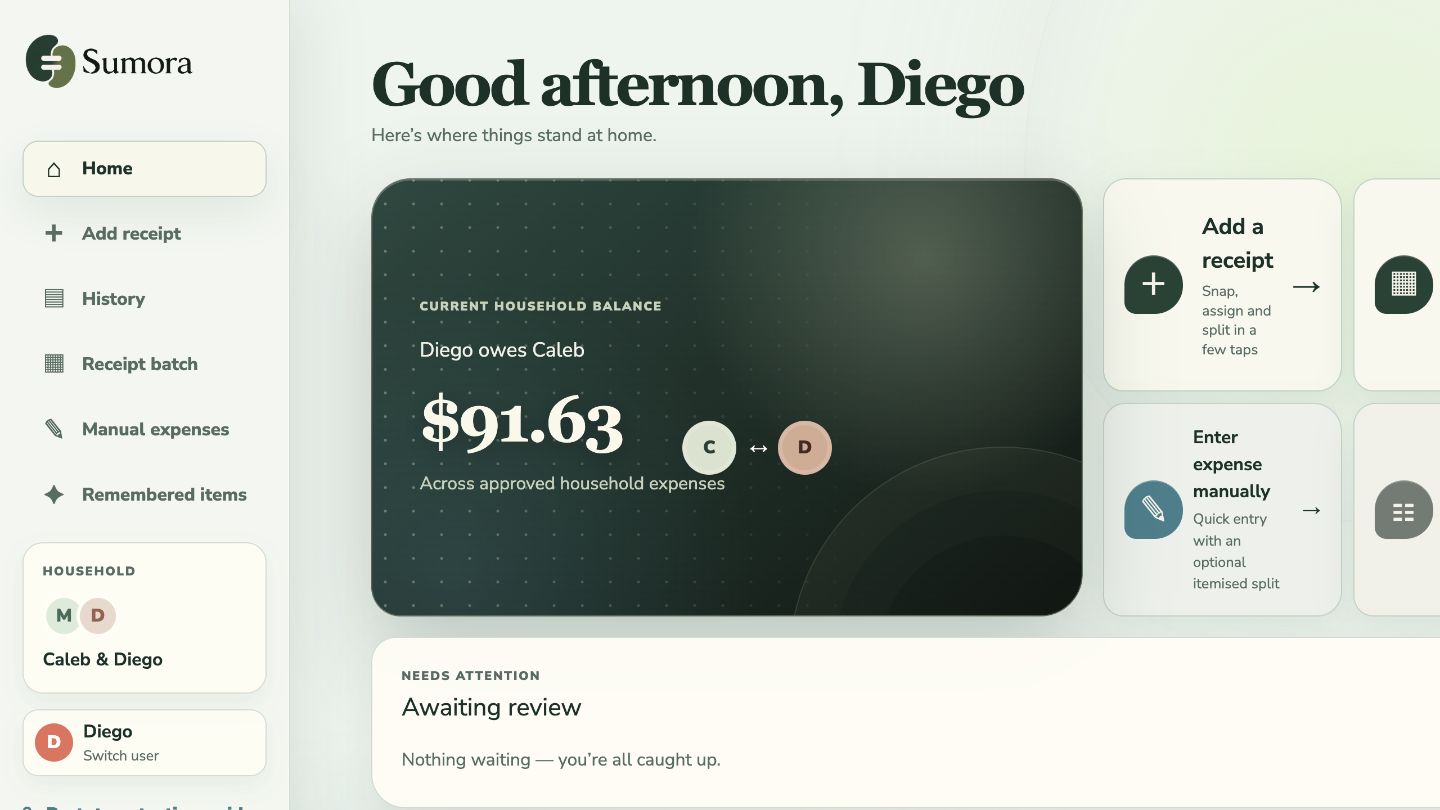
Sumora's household dashboard on desktop, showing the current balance between household members and quick actions to add a receipt or expense
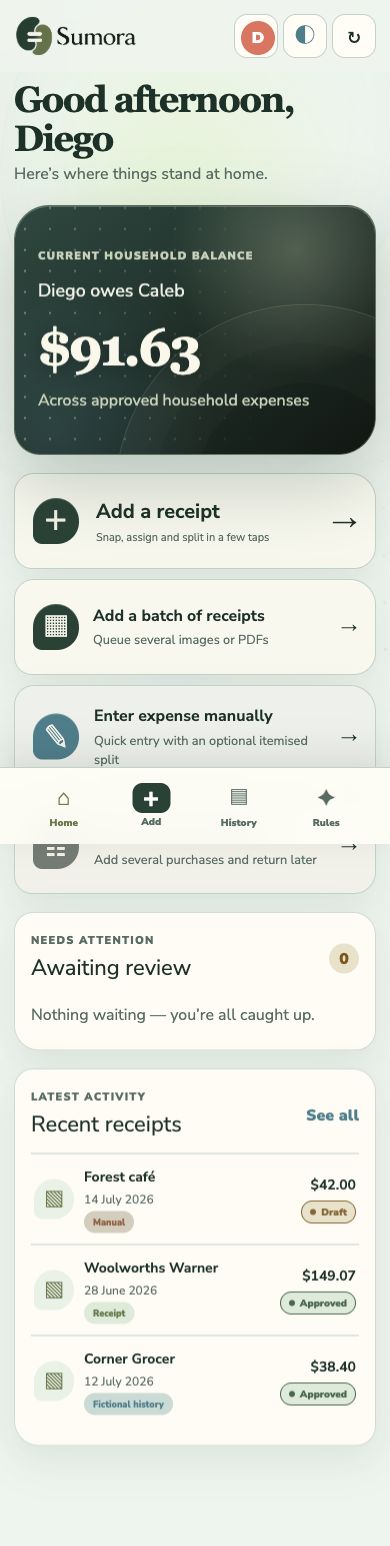
The same Sumora dashboard on a mobile phone, with recent receipts and their approval status listed below

What was built

Sumora is a private, mobile-first application that turns everyday receipts into a household ledger people can actually understand. It reads receipt items, keeps the original evidence, lets each person review who should pay for what, and calculates the resulting balance without hiding the decisions behind it.

Designed and built by Friendly Geek, Sumora brings product design, accessible interaction, financial data modelling, private infrastructure and careful operational engineering into one working application.

  1. 01

    Import a receipt

    Add a digital PDF, a scanned receipt or a photograph. Sumora extracts embedded text directly and can use private local OCR for images.

  2. 02

    Check the evidence

    Review the merchant, date, line items, discounts and total. Sumora makes mismatches visible and will not quietly invent a balanced result.

  3. 03

    Assign each item

    Mark an item as shared, personal, another member's responsibility or a custom split. The workflow handles the messy exceptions instead of pretending they do not exist.

  4. 04

    Confirm the financial result

    The verified items, payer and exact receipt total produce a clear household responsibility and balance.

  5. 05

    Review history and settle up

    Household members can see recorded activity, preserve cancelled records as audit evidence, confirm settlements and export authorised reports in PDF, CSV or XLSX format.

  6. 06

    Let the system assist, without taking control

    Sumora can suggest familiar classifications from previous household decisions. Suggestions remain advisory, reversible and subject to review.

Information design

Heartroot: a living instrument for household balance

Heartroot explores a different way to present financial state. Instead of reducing the home screen to a number and a chart, it translates confirmed household facts into an organic visual language.

A settled household rests in balance. An amount owed travels towards the member who is owed. A receipt awaiting review remains visible as an unresolved node. A pending settlement has its own signal. Cancelled or excluded activity stays outside the current financial truth.

Heartroot never calculates a balance and never commits an action. The exact amount, direction and next step remain in clear semantic text; the visual responds only after the server has confirmed the underlying state.

Its themes change material and silhouette, not just colour. Quiet daylight, mineral forms, bioluminescent threads, moss, mushrooms, wildflowers, orchids and a woodland hearth all share the same financial grammar. Reduced-motion users receive the same information without travelling animation.

The visual can make the state feel alive, but it is never allowed to become the source of truth.

Interaction and progressive disclosure

Household Weave shows what shaped the balance

The Heartroot investigation evolved into Household Weave: a calmer, explanatory view of the relationships behind a household balance.

Members act as anchors. Receipts appear as repeated stitches. Settlements use tied joins. A one-cent equalisation remains a separate crossed stitch rather than being disguised as spending. Cancelled history is detached and explicitly carries no current financial effect.

On a phone, the exact balance and actions come first, with the weave available when someone chooses to explore it. On larger screens, the financial summary, woven visual and plain-English material key form one coordinated surface. The same information remains available through text, keyboard navigation, reduced motion and high-contrast modes.

Private by design

Sensitive household data deserves more than a privacy promise

Sumora is built around explicit trust boundaries: PostgreSQL is authoritative for household finance and receipt metadata. Original receipt files live in private storage rather than a public media library. Image recognition can run through a local CPU OCR service. Household membership and role checks are enforced at server boundaries. Receipt files cannot be read across household or member boundaries. Reports are generated from one authoritative snapshot and recheck authority before returning a file. Financial submissions are designed to be replay-safe and exactly-once. Backups are restore-verified, releases preserve a rollback image, and the deployed build is identifiable.

Privacy is also part of the interface. Sumora separates source evidence, extracted text, suggestions, editable values and final records so people can see what the system knows, and what they have actually approved.

Accessible and resilient

Built for the awkward moments, not only the ideal demo

The work included small phones, landscape screens, large text, mobile software keyboards, reduced motion, forced colours, keyboard operation and cross-browser behaviour. Important controls are measured as real touch targets, not merely found by an automated locator.

The application also accounts for interrupted navigation, stale client state, duplicate submissions, cancelled receipts, former household members, unavailable visual data, storage failures and safe rollback after deployment. That level of detail is part of the product, not an afterthought added at the end.

What Friendly Geek delivered

  • PostgreSQL
  • Docker
  • GitHub Actions
  • Product discovery and household-expense modelling
  • Information architecture and mobile-first UX
  • Sumora identity and the Luminous Canopy visual system
  • Heartroot and Household Weave interaction design
  • Accessible responsive frontend engineering
  • Receipt extraction, reconciliation and private OCR integration
  • Authenticated household roles and server-side authorisation
  • PostgreSQL schema, migrations and financial integrity controls
  • PDF, CSV and XLSX reporting
  • Browser, database, security, accessibility and regression testing
  • Private Docker deployment, health checks, backups and rollback planning
  • Traceable GitHub release gates and software bill of materials

Sumora demonstrates the kind of work Friendly Geek can do when a useful idea needs more than a template: understand the real problem, design a calm experience, build the full system, protect the sensitive parts and prove that it works.

The screens shown in this case study use fictional or sanitised information. Private household receipts and account details are never used as showcase material.

Have a useful software idea that deserves careful treatment?

Talk to Friendly Geek about your idea